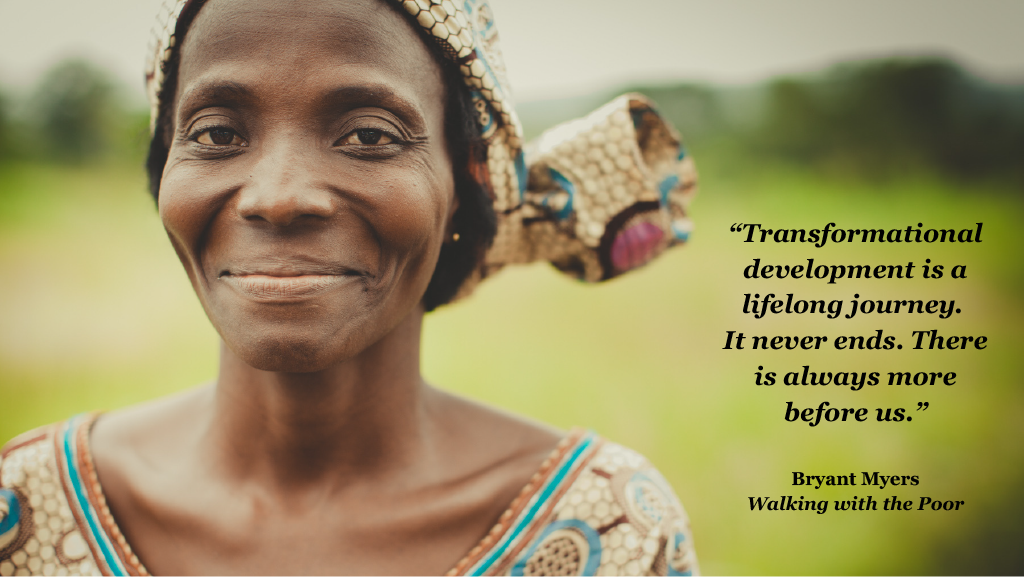
Bryant L. Myers, a towering figure in the space of poverty alleviation, passed into glory a few weeks ago. While I did not know Bryant personally, he had a tremendous impact on the work of the Chalmers Center, starting with an uncomfortable exchange we had during the winter of 1992…
My Ph.D. program in economics was mercifully coming to an end, so I was sending out my resume and a sample of my dissertation to prospective employers, including the Director of Research at World Vision—Dr. Bryant L. Myers. Given that my dissertation applied sophisticated mathematical and statistical tools to study an important issue related to poverty in India, I thought World Vision might be interested in hiring a person with my skills.
I could not have been more wrong.
Bryant responded to my inquiry with a very kind, yet pointed, rejection letter. He explained that the entire paradigm of economics—including my dissertation—was deeply flawed. In particular, Bryant took issue with economists’ assumption that human beings are fundamentally highly individualistic, rational, material creatures. As a result, he had no interest in employing somebody like me…ever.
Given that I had spent my entire life studying economics in hopes of helping people in poverty, Bryant’s letter was understandably discouraging. But the truth is that I didn’t fully understand what Bryant was trying to say. And to the extent that I did understand, I didn’t think his critique was completely fair. So, I quickly forgot about Bryant and accepted a position as an economics professor at a major research university.
But God wasn’t letting me off the hook. Over time, He made me increasingly uncomfortable with mainstream economists’ presuppositions about the nature of human beings, of poverty, and of human flourishing. Even though I’d forgotten about Bryant’s letter, he had planted a seed in me that God was watering.
While these thoughts were still percolating, Covenant College, a Christian liberal arts school in Lookout Mountain, GA, offered me a faculty position, giving me the opportunity to think about economics and poverty from a distinctly biblical perspective.
I barely knew where to begin, but God kept leading and guiding. And in 1999, a generous foundation granted funds to enable Covenant College to start an undergraduate major in Community Development and to launch the Chalmers Center. Both initiatives sought to address poverty from a distinctly biblical framework, even though I still had very little concept of what such a framework entailed.
Two of the first people we hired to help with these initiatives—Russell Mask and Steve Corbett—encouraged me to read a book called Walking with the Poor: Principles and Practices of Transformational Development, written by none other than Bryant L. Myers. I couldn’t seem to get away from this Myers guy!
The book is not an easy read. In fact, many of the concepts were new to us, so at times we struggled to understand what Bryant was saying. But over time, as we worked to develop various interventions, trainings, and curricula, we grew in our understanding. At times a light would go on and we’d exclaim, “Oh, that’s what Bryant was talking about!” It often felt like Walking with the Poor was walking with us!
In my humble opinion, Walking with the Poor is the best book ever written on poverty alleviation from a Christian perspective. It has profoundly shaped the Community Development Major at Covenant College. And every book and resource ever produced by the Chalmers Center has drawn heavily on this seminal work.
While space does not permit a complete summary of Walking with the Poor, its genius lies in its ability to articulate a distinctly biblical theology and anthropology and to apply it to the space of poverty alleviation.
Theologically, Bryant emphasizes that the Triune God is inherently a relational being. As such, He is actively engaged with every aspect of His universe, bringing healing and reconciliation as far as the curse is found. Therefore, efforts to alleviate poverty that separate the material dimension of the cosmos from its spiritual and relational dimensions, are deeply flawed.
Anthropologically, Bryant notes that as beings made in the image of the Triune God, human beings are also created for relationship. In contrast to Western secularism, which often reduces human beings to physical creatures, and to Western Christianity, which often focuses on the soul to the neglect of the body, Myers articulates the biblical truth that human beings are highly integrated body-soul-relational creatures. Material poverty—a lack of food, shelter, or clothing is typically a symptom of something deeper—the underlying relational brokenness that is common to all humanity.
These are not just abstract ideas, for as Myers explains, they have very practical implications for how we design, implement, and evaluate our poverty alleviation efforts.
For example, when a woman walks into your church asking for help with her electric bill, your response reflects your understanding of how she is wired. If you believe, like Western secularists (including mainstream economists), that she is a physical creature, you will respond by either giving her money or helping her to earn more. If you believe, like many Western Christians, that her soul is what really matters, you will respond with evangelism and discipleship. But if you believe she is a highly integrated, body-soul-relational creature, your response will be more holistic, walking in relationship with her as the Triune God does His work on both of you. For more detail, read Walking with the Poor or the numerous resources at the Chalmers Center that draw on this book!
Bryant’s insights have deeply impacted the lives of millions of the poorest people on the planet. But they’ve also brought hope and healing to the non-poor as well. For as Bryant notes, every one of us is suffering from broken relationships, so all of us need Christ’s reconciling work. As he explains in Walking with the Poor:
Transformational development is a lifelong journey. It never ends. There is always more before us. Everyone is on this journey: the poor, the non-poor, and the staff of the development agency. The transformational journey is about finding and enjoying life as it should be, as it was intended to be. In this book I suggest that the goals for this journey of transformation are to recover our true identity as human beings created in the image of God and to discover our true vocation as productive stewards, faithfully caring for the world and all the people in it. (Myers, Walking with the Poor, pp. 3-4)
Bryant, thank you for helping us to understand what biblical poverty alleviation is all about. Thank you for helping us to understand the Gospel in its fullest.
Comments
-
I am blessed by this Brian. While I did not know Dr. Myers, I did get to know Chalmers & your work which ultimately led me to reading & studying “Walking with the Poor”. My life, discipleship journey & paradigm was & continues to be transformed by what appeared to be a “rejection/rebuttal”. May it be forever so!
Blessings ! -
Thanks for your testimony that highlights the contribution of a former colleague to the full understanding of concepts like poverty, holistic transformation, integral mission, and others!
-
What a gracious testimony to the life of Dr. Myers and his influence upon Brian and the Chalmers Center. To God be the glory – and in reading this, one also learns of the academic trajectory of Brian himself. Perhaps only those of us in the academic marketplace can appreciate how radical was Brian’s move from a major research institution to an undergraduate liberal arts college that has the Christian faith as its foundation.
-
I’m Kiplagat from Kenya. As a student of Bryant Myers at Fuller Theological Seminary, my journey with him began long before I stepped into his classroom. It was through the pages of Walking with the Poor that I first encountered a paradigm that would fundamentally reshape my understanding of mission and discipleship. That book became the catalyst for my own vocational calling, compelling me to take a step of faith—not merely to study his work, but to missionally sit under his feet and learn what it means to accompany the poor in holistic transformation.
Myers’s greatest gift to me was the deconstruction of a theological framework I had unknowingly absorbed: a Western dualistic mindset that artificially divorces the spiritual from the physical, treating material poverty as a “secular” problem and evangelism as the sole “sacred” response. He exposed this as a form of bad theology—a reductionism that betrays the biblical narrative of shalom and the integrated nature of God’s redemptive mission. By reframing poverty as the breakdown of relationships with God, self, others, and creation, Myers invited me into a more faithful and incarnational approach. Poverty is no longer a problem to be solved but a web of brokenness to be entered, and the poor are no longer objects of our charity but subjects of their own agency and partners in God’s mission.
Today, in small but intentional ways, I strive to continue his work—resisting the urge to impose quick-fix solutions from a place of privilege, and instead practicing the patient, listening posture of accompaniment that Myers so rigorously advocates. Whether in community development, pastoral care, or daily life, I seek to embody the integrated gospel he articulates: one that addresses both the spiritual and material realities of human flourishing.
I also want to express my deep appreciation for your own contributions through the Chalmers Center. Your writings and the reflections on your website have been a rich resource for me, grounding Myers’s principles in practical, on-the-ground wisdom. I visit often, and each time I am challenged, encouraged, and equipped to think more deeply about how to faithfully walk with the poor in my own context. Thank you for extending this vital work into the global church and for modeling what it means to learn from and alongside communities on the margins.
-
Incredible tribute! Amazing to see how His Kingdom falls out on earth through people like Dr. Bryant Myers. People who devote their lives to feeding His sheep, physically, mentally/emotionally and spiritually. Body, Mind, Spirit!


Leave a Reply