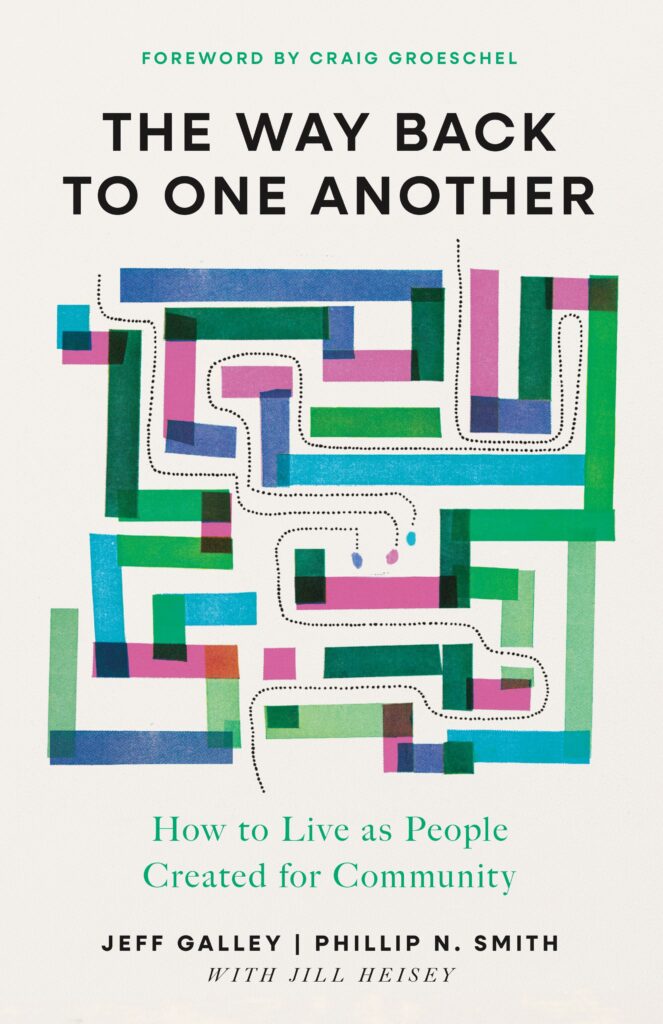
Editor’s Note: We’re very excited for this book from two wonderful friends of Chalmers, Jeff Galley (who is our current board chair) and Phil Smith who serves with our partners at Hope International. We believe you’ll be blessed by their work, and want to share an excerpt here for you.
Taken from The Way Back to One Another by Jeff Galley and Phillip N. Smith. Copyright © 2026 by Life Covenant Church Inc. and HOPE International. Used by permission of InterVarsity Press. www.ivpress.com
At first glance, “love one another” seems a simple enough instruction to comprehend, if not a difficult one to follow. In the earliest days of Christianity, those who received that command walked closely with Jesus himself. When he decreed “love as I have loved,” specific memories and interactions almost certainly came to mind. But soon the gospel spread. First to 120 believers (Acts 1:15), then to more than 3,000 (Acts 2:41), “and the Lord added to their number daily” (Acts 2:47).
Outside the epicenter of Jerusalem, the gospel advanced as new believers returned home and others embarked on missionary journeys, faithful to Jesus’ call to “make disciples of all nations” (Matthew 28:19). These new converts lacked the benefit of rubbing shoulders with Jesus while he walked the earth. They couldn’t call on personal experience to know what his love had looked like.
Roughly half of our New Testament is attributed to the apostle Paul, and much of his writing took the form of letters to these believers in the early Christian world. In Paul’s letters, he added clarity to how those who wanted to walk in the way of Jesus should love one another.
In letters contextualized to his recipients, addressing both sound doctrine and godly living, he spoke to challenges they were facing and offered encouragement. To the ethnically diverse church in Rome, Paul wrote “accept one another” (Romans 15:7). To the church in Ephesus, which was beset by “fables” (1 Timothy 1:4 KJV), Paul instructed, “Speak the truth in love” to one another (Ephesians 4:15 NLT). To the church in Galatia, whose insistence on submission to Mosaic law for new believers resulted in division within their ranks, Paul cautioned they must not “bite and devour” one another but should instead “serve one another humbly in love” (Galatians 5:13, 15). Rather than finger-pointing and condemning those they believed to be wrong, Paul said they must “carry each other’s burdens,” writing, “in this way you will fulfill the law of Christ” (Galatians 6:2): the law of love.
Additional one-another instructions included:
- Be kind and compassionate to one another. (Ephesians 4:32)
- Bear with and forgive one another. (Colossians 3:13)
- Strive to do what is good for one another, and don’t repay wrong for wrong. (1 Thessalonians 5:15)
- Be devoted to one another in love. (Romans 12:10)
- Consider one another as more important than yourselves. (Philippians 2:3 NASB)
- Encourage (or comfort) one another. (1 Thessalonians 4:18; 5:11)
These were messages that each group of recipients needed to hear. Each gave greater clarity and form to Jesus’ “love one another” command. As we read these letters that were written for us but not to us, they remain truth-filled and God-inspired.
But we acknowledge that some of our context has changed since Paul penned these letters. For instance, greeting one another with a holy kiss (Romans 16:16; 1 Corinthians 16:20; 2 Corinthians 13:12; 1 Thessalonians 5:26) might not fly in the United States today (though perhaps in many other cultures it still could!). Obviously there are also lifestyle and technological changes that Paul wouldn’t have accounted for in his letters. So what might it look like to live out ezer (“help” or “helper”), allēlōn (“one another”), and koinōnia (“each-to-all fellowship”) today, particularly in light of the growing epidemic of loneliness and the associated impacts?
We’ve pondered all this and wondered, if Paul were writing to the church in the United States today, what one-anothers would he emphasize? What aspects of our culture (both “Christian” and secular) would he address, and how would he encourage us to love one another in the countercultural way of Jesus? Once again we were guided by our sisters and brothers in the global church as we visited savings groups around the world.
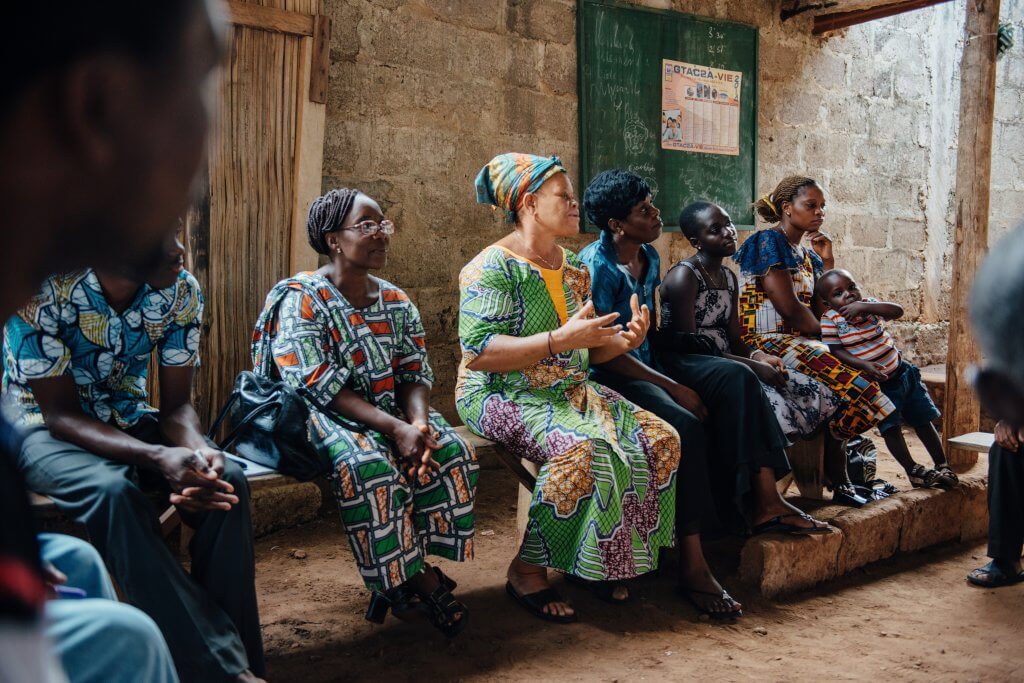
We’ve seen savings group members transcending their cultural context to embrace the culture of Christ’s kingdom—and their practices looked very similar, whether they were living in Haiti, Rwanda, or Peru. As we sat at the feet of these Christ-centered communities—practitioners of ezer, allēlōn, and koinōnia—and learned from them, we were filled with hope that we, too, can overcome aloneness together.
What we saw in these savings groups not only piqued our curiosity and inspired us but also revealed some postural and practical shifts we must make—some contextualized one-anothers—to become a people known for our love not our loneliness.
These are not new (unbiblical) inventions. Rather, they are a contemporary articulation of what we suspect Paul and the New Testament writers might call out within our context.
- Depend on one another: Where we’ve witnessed true koinōnia, it has been among communities that embrace interdependence— both in mindset and in practice—consistently prioritizing “we” over “me.”
- Know one another: Members feel safe with and loved by one another. Even with faults in full view, they know they belong. The safety they experience in these relationships allows them to become remarkably open and vulnerable with one another.
- Talk with one another: Members gather, share, talk, and listen to each other well beyond the bounds of prescribed or customary interactions. They take the time to understand one another.
- Welcome one another: These communities are simultaneously close-knit and welcoming. They see themselves as people who have been welcomed in, and, in gratitude, they are quick to welcome others.
- Commit to one another: Koinōnia communities model deep relational commitment and tenacity, actively serving, encouraging, and caring for their sisters and brothers.
Why these five? First, we found that many of the scriptural “one anothers” are embedded in each of these five concepts. For example, committing to one another produces the fruit of helping one another and bearing one another’s burdens. Second, from interviews, observations, and statistics, we can see that each of these areas is lacking in our current cultural climate, and we believe each is a vital step on the path back to one another.
Each of these “ingredients” is a key part of God’s recipe for community. While living in Africa, I (Phil) savored Rwandan ginger tea: a mixture of milk, sugar, fresh ginger, and black tea leaves harvested nearby. While each of those ingredients may be appreciated in its own right, they only make Rwandan ginger tea when combined. Remove one of the ingredients and the finished product is something less than what it’s meant to be. The whole is more than the sum of its parts. Moreover, once combined, the ingredients can no longer be separated. So it is with these one-anothers.
Each “ingredient” of community permeates the others. Interdependence breeds commitment, and talking to one another allows us to know and be known by others. This relational richness and security encourages a welcoming posture, inviting others to experience what we’re experiencing. While each one-another may be viewed separately as a vital ingredient in our Christ-centered communities, they become exponentially more beautiful as they permeate and enrich the others.
By taking small, intentional steps toward embracing and integrating these one-another ingredients, we will, like our global teachers, become people who experience and foster deep and loving relationships and community. We wish we could invite each one of you to see ezer, allēlōn, and koinōnia as we’ve seen it embraced in communities around the world.
But perhaps there’s a still-better invitation we can extend: Be a part of creating it in your own community. God’s design for relationships and community—ezer, allēlōn, and koinōnia—offers the antidote to the loneliness epidemic, and it’s available to each of us as we obey Christ’s command to love one another. It’s as simple and as hard as that.
To learn more about the book, visit: https://www.ivpress.com/the-way-back-to-one-another.
Jeff Galley is the Central Group Leader for Community at Life. Church, where the church aims to lead people to follow Jesus and love their neighbors through the power of community. He is the author of Conversations: Turn Your Everyday Discussions into Life-Giving Moments. He co-leads Global Lift Collective and serves on the board at the Chalmers Center for Economic Development and Tearfund USA. Jeff and his wife, Christy, have three married children, three grandchildren, and live in the Oklahoma City area.
Phillip N. Smith is the Senior Development Ambassador at HOPE International. He previously served as HOPE’s senior director of savings group programs, leading the organization’s global team. Prior to joining HOPE, Phil served as an executive pastor, corporate executive, and in senior leadership with World Relief, and has served on many boards over the years. Phil and his wife, Becca, have lived in the United Kingdom, Canada, and Rwanda, and currently reside in Lancaster, Pennsylvania. They have two sons, a daughter, daughter-in-law, and two grandchildren.

Leave a Reply