Chalmers is taking an exciting step in our partnership with the Free Methodist Church (FMC) in Latin America as we equip them to implement and scale Innovate: Local. This training prepares local churches and para-church ministries in the Majority World to use their own talents and resources to develop holistic poverty-alleviation ministries that meet the unique needs of their communities. Empowering participants to create and launch their own solutions helps ensure local commitment to long-term change.
We have already piloted Innovate: Local in Nicaragua and Ecuador, and now, FMC leaders want to adopt Innovate: Local as a core discipleship tool across their network of house churches—the FMC’s primary model for church planting in Latin America. In the coming year, the FMC will expand implementation in Argentina and Colombia.
Tanya Rosado serves as a coordinator of the FMC’s “Empowering Holistic Transformation” program. This program aims to develop healthy leaders who train disciples, groups, and churches in that transformative vision; these groups are the three pillars of the program.
“The Free Methodist Church in Latin America exists to participate with God in the restoration of Latin America,” Tanya says. “Part of my role has been to ask what this is going to look like for our Free Methodist churches in Latin America. What materials do we have? What do we not have? What would our training look like?”
As Tanya began her assessment, a colleague told her about the Chalmers Innovate: Online training. Intrigued, Tanya and her team took the course and decided it could be a good fit for FMC’s vision. “The design thinking was new to me, and the way it was put together,” Tanya says. “Why recreate the wheel?”
When an opportunity came up to pilot our newest training, Innovate: Local in Nicaragua, Tanya and her team jumped at the opportunity, pulling the training together in just two months. The event proved instructive in a variety of ways.
We saw a lot of transformation happen. But we had struggles. A lot of the groups couldn’t finish because people kept moving away, so a group would shut down and the facilitator would try to start again.
Tanya Rosado, Program Coordinator
We started a process of figuring out how we were going to do this effectively. Our house churches, which we call Houses of Peace, have a discipleship curriculum. I was thinking, let’s insert Innovate in the discipleship program for our Houses of Peace. It teaches people about why this is important — why is holistic transformation part of God’s mission for us? And it really does work to restore broken relationships.
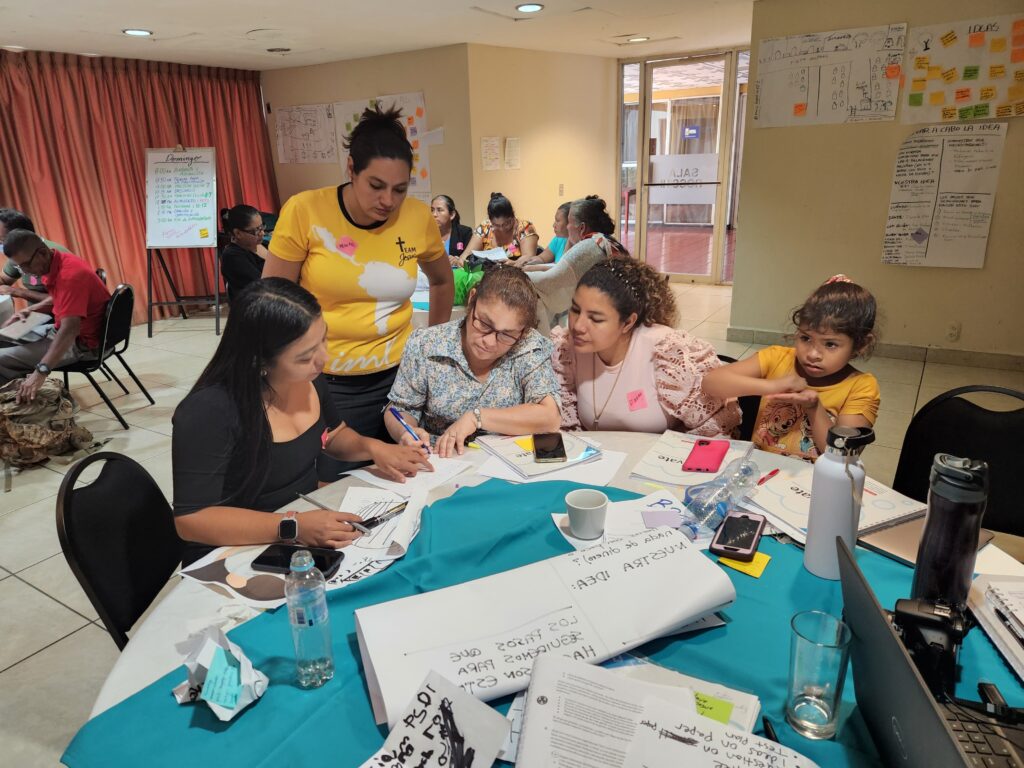
Transformation in Action: A Story of Hope and Growth
This process of discovery has led to holistic transformation for many participants, including Martha. A quiet and shy person, Martha didn’t necessarily reflect the demeanor of a charismatic leader when she was first trained to facilitate Innovate: Local in Nicaragua. She had never taught a class. She had never spoken in front of a group. But over time, Martha grew so much in her knowledge of Innovate, and confidence in her ability to teach it, that she now serves as the Innovate: Local coach for Nicaragua. “She teaches with an authority,” Tanya says. “She has this belief in herself now. That’s where it is: this restoration with herself, that she knows she can do this work.”
Martha will soon begin teaching the program in El Salvador as well. “I remember where she started and where she is now,” Tanya says. “I get really excited about how Innovate was so crucial to her development. As she helped other group leaders, she began to recognize her gifts and see who God made her to be.”
Martha is living the vision of Innovate: Local — a believer restored, empowered, and released to facilitate healing and growth in the Church.